Where the Flags Change: Inside Israeli-Occupied Southern Lebanon
Drive south along Lebanon's coast and the Hezbollah flags give way to Israeli ones. Beyond them, whole villages are gone. Notes on a CNN report from the occupied zone, and what I make of it.
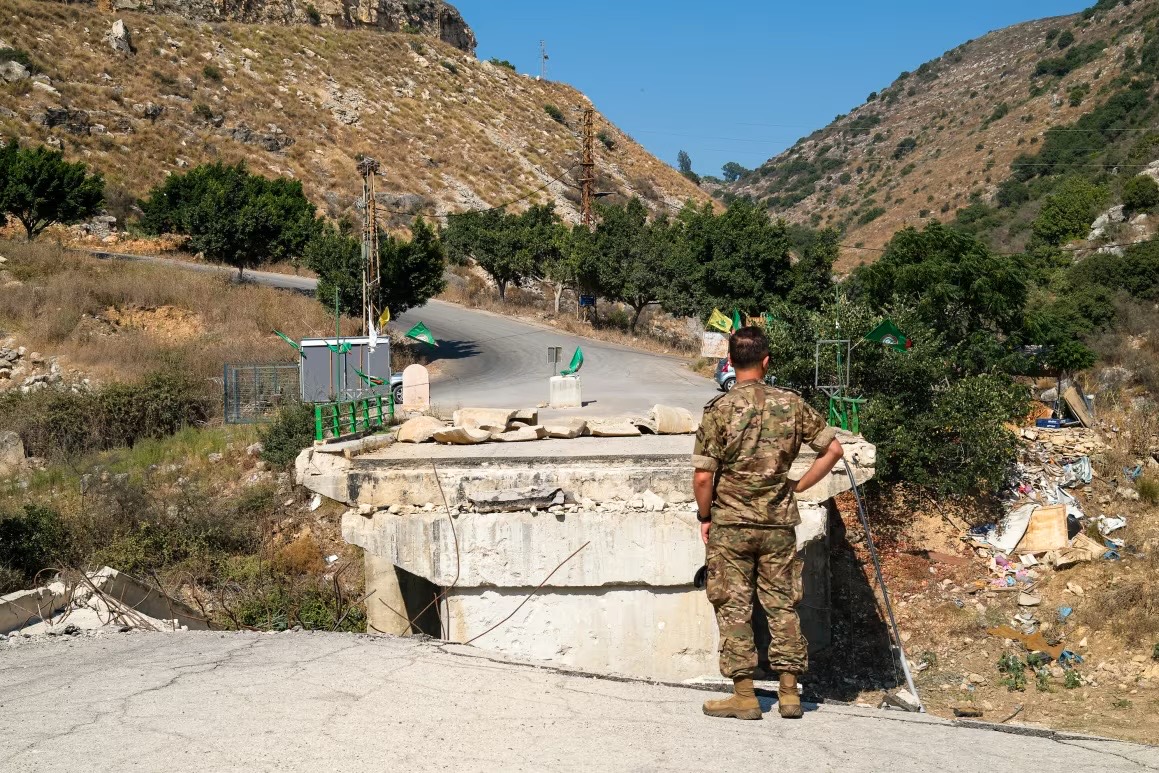
There is a road along the coast of southern Lebanon where the flags change. Lebanese flags and Hezbollah banners line the shoulder, and then, without warning, they are Israeli flags. Next comes a checkpoint. Then soldiers watching from the balconies of houses pocked with shrapnel. And then the land goes flat. Where villages stood, there is now level ground.
CNN drove that road recently, riding in a UN-organized convoy of residents allowed back into three Christian villages inside the Israeli-held zone. I read the report several days ago and have not been able to put it down. So I am writing it down.
What happened
- Israel invaded southern Lebanon in March, after Hezbollah resumed attacks on Israel to avenge the assassination of Iran’s Supreme Leader Ali Khamenei.
- Since then the Israeli military has held a strip of territory roughly 10 kilometers deep, which it calls a “security zone.” Israel’s defense minister pledged to destroy every home in the villages near the border. On the ground, that pledge has been kept.
- Lebanon’s health ministry counts more than 4,300 people killed by Israeli strikes since March 2. The UN says more than 350,000 remain displaced.
- A ceasefire is nominally in effect. Israeli strikes continue daily. Israel says the latest agreement allows this.
- Three Christian villages inside the zone, Rmeish, Ain Ebel and Debel, were spared the bombardment. They were not spared isolation. Nobody enters or leaves except by UN convoy, and each resident must be individually approved by the Israeli military through a US-led monitoring mechanism.
Why it looks like this
Israel’s logic is simple. To protect its northern towns from rockets, the land across the border must be emptied. “Emptied” has come to mean, literally, bulldozed. The surrounding Shia Muslim villages have been erased one by one through airstrikes, demolitions and controlled explosions. Residents of the remaining Christian villages say they hear the blasts from neighboring communities every day.
The Lebanese state can do nothing inside its own territory. A US-brokered framework signed in June was supposed to hand small “pilot zones” back to the Lebanese army. The first three zones were villages Israel never fully occupied in the first place, which is why many doubt Israel ever intended to withdraw. The Lebanese soldiers patrolling those zones earn about $500 a month with aging equipment. Thirty-four of them have been killed this year.
What I make of it
What stayed with me was not the numbers. It was two scenes.
One. A husband driving his wife and two daughters back to their village after four months in a rented flat in Beirut, then turning around to go back to his job in the city. “We were four,” his wife said through tears, “and now we will be three.” A village that escaped the bombs does not escape the war. The price is paid in a family split down the middle.
Two. A father in Ain Ebel whose two-year-old son can already recognize the sound of a fighter jet and no longer wakes up when the strikes come. He blames Hezbollah for starting this. And in the same breath, looking at the flattened Shia villages next door, he says nobody deserves this, and that they all have to live together.
I think that second man’s position is close to the only honest one available. The fact that Hezbollah fired first and the fact that dozens of villages have been wiped off the map do not cancel each other out. Both are true. A “security zone” stops being about security the moment it erases the people who lived in it; at that point it is an occupation.
It is also true that the Lebanese government is weak. But if the answer to a weak state is a foreign army hollowing out the borderland, that answer becomes the cause of the next war. Calling a situation with 4,300 dead, 350,000 displaced, and soldiers who no longer flinch at shells landing in the next village a “ceasefire” is already a kind of lie.
The world will forget this in a few days. That is why I am writing it down. At the end of the road where the flags change, there is a family of three that used to be four, and a two-year-old who sleeps through airstrikes.
Source: CNN’s on-the-ground report from southern Lebanon (September 2026). Casualty and displacement figures are from Lebanon’s Ministry of Health, the UN, and the Lebanese Armed Forces, as reported by CNN.